The tourism sector is one of the fastest growing economic sectors in the world (Hojeghan and Esfangareh, 2011), and the digital economy has no doubt been a key driver in its expansion (Bearne, 2016). The travel agent has gradually been shifted to the side – the collapse of Thomas Cook last year is a prime example. The world’s oldest travel company going bust sparked debate around the relevancy of travel agents in this new era of digitalisation (Bearne, 2016). The internet has allowed individuals to book their flights, accommodation and places to eat all at the click of a button. Individuals are able to plan every aspect of their holiday for themselves with minimal risk – online reviews and pictures are utilised before they even arrive in a country. The way people travel has fundamentally changed. Consumers no longer want to be confined to the restrictions of a travel agents all-inclusive booking system. People have become more exposed to other countries and cultures via social media and blogs that are dedicated to travel. They provide tips and tricks for readers to travel independently, such as this blog called The World Pursuit.
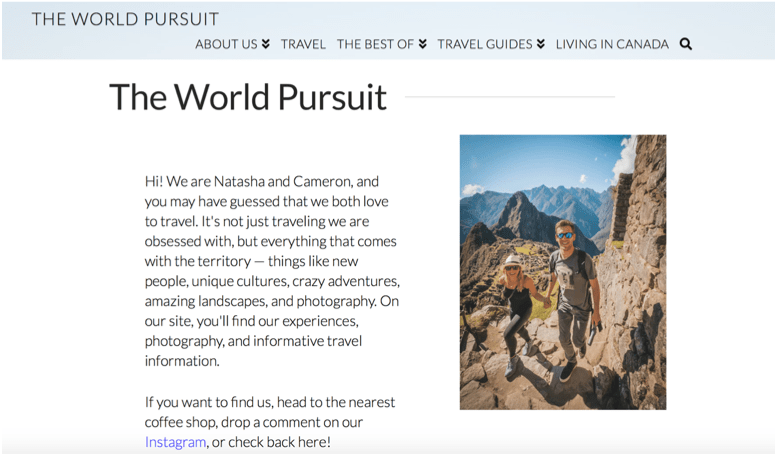
Screenshot of The World Pursuit Blog. Retrieved from: https://theworldpursuit.com
A travel consultant is traditionally the person in the travel agent that organises and promotes all the aspects of a holiday for their customers, including flights and accommodation. Airbnb is an online platform that allows travellers and holidaymakers to organise to stay in local people’s homes. It has accentuated the trend towards “authentic” experiences (Nevill, 2018). People have started to crave local experiences from novel cultures. Independent travelling has becomes the new craze. Does this mean the travel consultant has become outdated?
The travel consultant role interests me because I work for a small independent travel company which organises ethical overseas expeditions for schools all over the UK and further afield called STC Expeditions. They offer a tailored experience, taking into account the schools specific demands. They have only been around a relatively short amount of time in terms of the travel and tourism economy. They therefore set up their business during the digital economy period – the company has all its database online and is able to make contacts online. The travel consultant still has to travel themselves to solidify relationships and make sure the places are how they are described. Digitalisation has made it easier to forge these connections, but does not get rid of the need to visit these countries before the customers. The internet has enhanced the travel industry in this way. It has allowed travel consultants to access more remote areas and businesses to offer their customers more unique and “authentic” experiences.
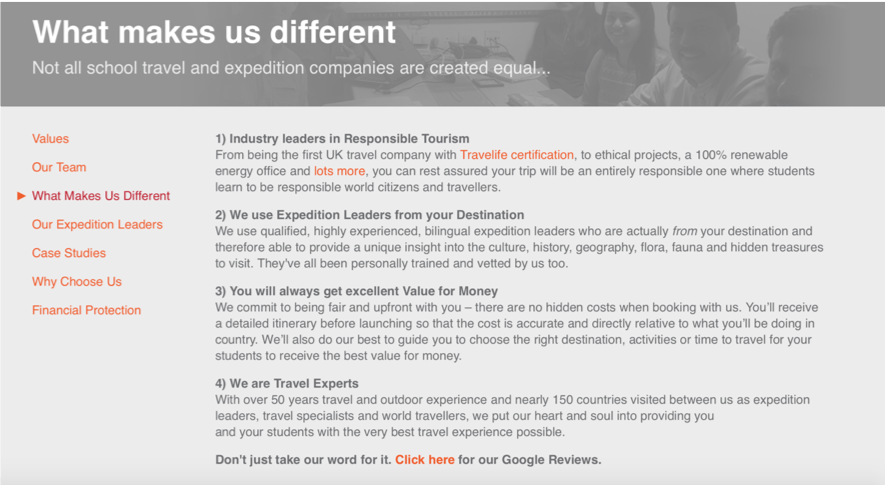
Screenshot of STC Expeditions ‘What Makes us Different’ Page. Retrieved from: https://www.thestc.co.uk/company/what-makes-us-different/
The slight spanner in the works is that for these connections to be made, the countries they are forming relationships with need to be part of the digitalised economy too. Remote areas in Africa have been left out of the tourism boom that has helped other parts of Africa (Nevill, 2018). This is because they are not developed enough to offer the standards of cleanliness and comfort for tourists, and they also do not have the technology to forge the contacts with the travel consultants (Nevill, 2018). In a sense, this could be an avenue for travel consultants to access in the future – the most remote areas in developing countries. This may require greater investment into travelling further afield to discover these hidden gems. There are also suggestions of travel consultants changing their title to travel ‘advisors’ – a transition to organising every detail of someone’s holiday or business trip (Elliot, 2018). For example, making restaurant reservations and sorting out all of the customer’s documents (Elliot, 2018).
When I was at school, I went on an overseas expedition to Morocco which was organised by another independent expeditions company. Looking back the relevance of travel consultants that organise trips for big organisations such as schools and businesses will never be outdated. Neither the student, the parents nor the teacher would ever plan an overseas trip from scratch – it simply is not their job. There are still organisations that require travel consultants to plan their trips for them – the demands have just changed slightly.
Despite the slow demise of the travel agent, the travel consultant is not dead in the water just yet. The digital economy has arguably enabled the travel consultant to access a larger proportion of travel destinations. The travel agents and its consultants have of course had to undergo significant changes – those that have moved with the times have survived and those stuck in the past have not lasted. The digitalising economy has allowed companies to forge contacts with independent overseas companies to offer new and personalised cultural experiences to their customers. In the future, it is possible they will create contact with even more remote areas as they start to develop. There may also be a shift towards holiday planning for organisations, rather than families – a switch from the ‘travel consultant’ to the ‘travel advisor’.
Reference List:
Bearne, S. (2016) How Technology has Transformed the Travel Industry. Retrieved February 12, 2020 from: https://www.theguardian.com/media-network/2016/feb/29/technology-internet-transformed-travel-industry-airbnb.
Elliot, C. (2018) This is why travel agents want to be called travel advisors. Retrieved February 12, 2020 from: https://www.forbes.com/sites/christopherelliott/2018/11/11/this-is-why-travel-agents-want-to-be-called-travel-advisors/
Hojeghan, S. B. and Esfangareh, A. N. (2011) Digital economy and tourism impacts, influences and challenges. Retrieved February 12, 2020 from: https://www.researchgate.net/publication/251714067_Digital_economy_and_tourism_impacts_influences_and_challenges
Nevill, H. (2018) Does the digital economy provide tourism opportunities for local communities in Africa? Retrieved February 12, 2020 from: http://blogs.worldbank.org/psd/does-digital-economy-provide-tourism-opportunities-local-communities-africa
Seagle, C. and Alden, N. (2020) The World Pursuit. Retrieved February 12, 2020 from: https://theworldpursuit.com
STC Expeditions (2020) Ethical School Adventures Since 2006. Retrieved February 12, 2020 from: https://www.thestc.co.uk
 Digital Business Models
Great piece! I found your discussion of the rising consumer desire for the ‘authentic’ very interesting. My question is whether the digital economy has spread and popularised the authentic to a point that it is no longer authentic. I have thought about the travel advisor and how the average person can also participate in this role. Surely, anyone sharing their opinion of travel in a digital space can be classed as an advisor as others may base their travels off yours. However, this is not a true representation but a social media ‘highlight reel’. Blogs such as ‘The World Pursuit’ become so popular that the authentic becomes the norm, all facilitated through the anyone travel advisor.
Will the ‘hidden gems’ below stay hidden as they are blasted across the internet?
https://www.telegraph.co.uk/travel/destinations/europe/spain/articles/spain-best-unsung-secret-destinations/
LikeLike