Hi, I am Caro and I am 21 years old. I am currently enrolled on the MSc International Business program at the University of Exeter. I previously studied BA Geography also at Exeter, graduating in June 2019. A little bit of a change in pathways! All the modules on my course have been different from the ones I was part of in my undergraduate program. This module (Digital Business Models) seemed again even further away from the modules I have studied before. It looked like an interesting module due to its relevancy in the modern world. And will only continue to be more relevant as I move into the working world! I have not had much experience in online learning and blog writing, so I am looking forward to trying out these new ways of learning! I would love you to share your thoughts with me on my blog posts to come!
The BEMM129 module has been a unique and insightful module – one that has been far different from any module I have taken throughout my whole time at university. This final blog post looks reflectively at the module and what it has made me think about and how it has helped my learning for future professional development.
The topics covered throughout this module have been interesting in the sense they are extremely relevant for life at the moment during lockdown due to the coronavirus. I am not sure any of us could have precited their relevance for the current times. The first week of the module was based around AI and its usefulness in society. The forcing of non-essential shops to shut in the UK and around the world has meant that stores that rely on their physical outlet to make money have gone under. Whilst those that are able to carry on business-as-usual online are able to keep above water during this time.
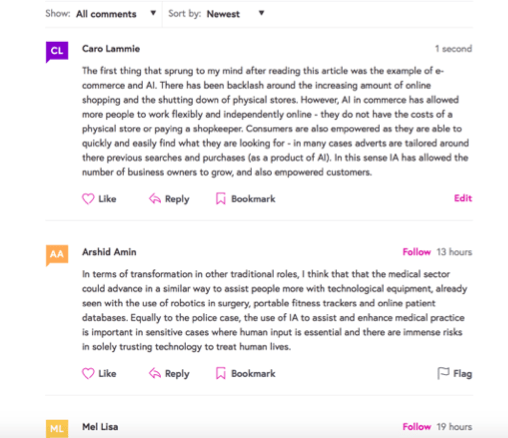
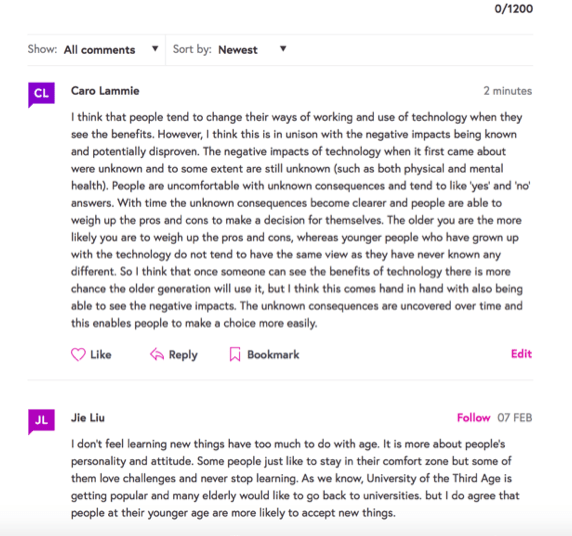
Screenshot of my AI comment on MOOCScreenshot of my technology comment on MOOC
The recent coronavirus outbreak has led me to think further about the digital economy and the advantages it offers to working practices. People have had to start working from home to prevent the spread of the virus. Fortunately the digital economy has made this much easier – online databases are available wherever you are as long as you have an electronic device and the internet. Business is able to carry on partly as usual. This module has moved in line with the trend towards online learning and working – we have not needed to be anywhere at a particular time. All the work and discussion has taken place online. We have been given autonomy over our time. It has definitely helped me working for all my modules online at home at the moment and I am sure the workplace will increasingly look like this in the future.
This was also interesting in terms of the four-day working week and how this has aimed to alleviate work-life balance. It was intriguing to hear feedback on my comment by another participant on MOOC about the relevance of supply of technology on the enforcement of the four-day working week in companies – a factor I had not previously considered. This was also the case for the contributions made about smart cities. I had not realised there were so many smart cities around the world and how much they varied.
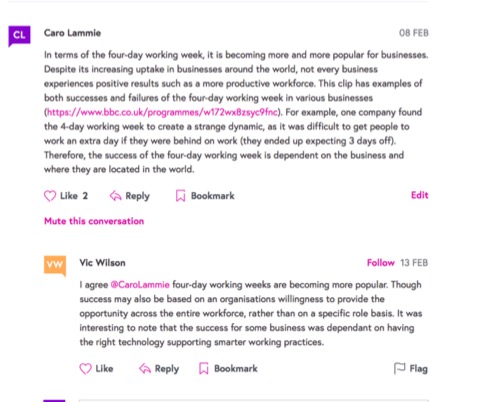
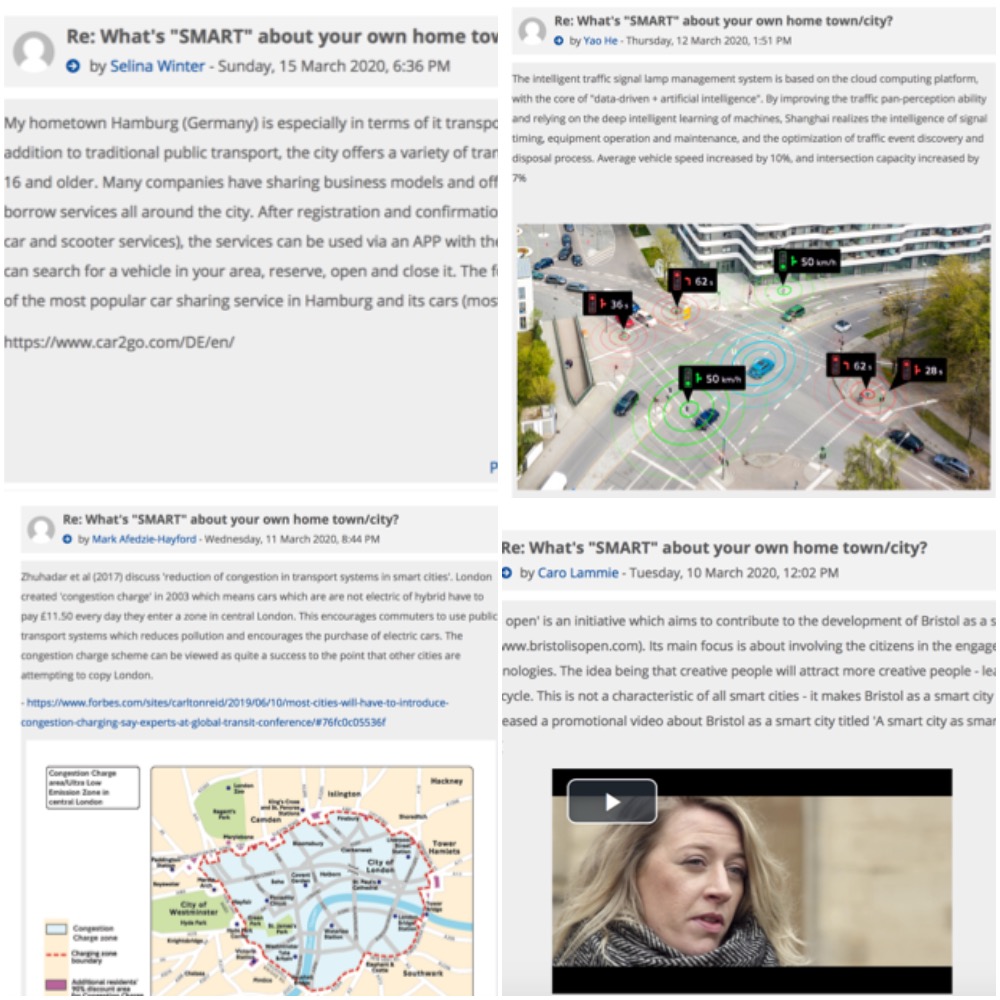
Screenshot of my four-day working week comment on MOOCScreenshot of some of the SMART city comments
The video below outlines what I have learnt in this module which I will bring forward into my future professional development.
It is every shoppers dream to get their product or service without paying for it. Klarna has made this dream a reality – or just about anyway. Klarna is an online platform which has replaced the checkout service on a company’s website (Business Model Zoo, 2020). The CEO of the company described it as “separating the buying from the selling” (Sebastian Siemiatkowski; cited in Loizos, 2015). It essentially allows customers to buy products and pay in interest-free instalments later (they can decide over how long a period of time). It does not carry out credit score checks, but rather looks at data such as when the product was bought (if something was bought at 3am this may ring alarm bells) (Loizos, 2015). Customers do not have to provide their payment details to the merchant and it reduces fraud as the products can only be sent to the registered address (Skinner, 2015). This all sounds great for the customer, but what is in it for the company apart from a monthly fee? By using Klarna customers are going through less hoops – they simply type in their email address and postcode. This speeds up the purchasing process, making it much more likely that the purchase will go through. This means more sales for the company using Klarna (Skinner, 2015). On average there are 1 million purchases a day using Klarna and over 130,000 merchants using the company (Business Model Zoo, 2020).
Klarna (2020): Video of Klarna’s ‘pay later’ business model
I came across Klarna on one of my favourite places to spend my free time – ASOS. I have spent far too many hours scrolling through the pages and pages of clothing, adding things to my basket, and never actually ending up purchasing them. A student’s budget did not cover the costs of my ridiculous basket costs at the end of a harmless browse. When ASOS started using Klarna a few years ago, things changed. Although I was not able to buy everything in my shopping trolley, I was able to make purchases over a longer period of time in smaller invoices every month – every student’s dream! I was also able to buy things in various sizes to see which would be best without the money coming out of my account straight away.
Klarna have also managed to reduce the risk of fraud as customers do not have to enter their details at the checkout. Instead they pay Klarna via bank transfer or online payment using the invoice they receive (Klarna, 2018). Any issues the customer has with the product they can go through Klarna to sort it. This digital disruption of the checkout system has led to changes in patterns of consumption – the customer often consumes more and is in greater control of paying for their purchases. Consumerism is encouraged with this digital platform and this is part of the reason why it has been so successful.
Klarna’s success has created a copying effect – other businesses have seen what a great model this is and tried to create a similar one. Stripe is one of Klarna’s biggest competitors and earns double the revenue of Klarna despite them coming into the market after Klarna (Loizos, 2015). Klarna’s founder has said they think that the company is amazing and they support them, however, their business model is fundamentally different (Loizos, 2015). Other businesses may take advantage of Klarna’s idea and saturate the market, however, Klarna have a good reputation and are used by some of the biggest companies in the UK alone (Loizos, 2015).
There is an ethical issue that comes with Klarna – is it setting up millennials (like myself) to become caught up in debt? (Lunn, 2018). Arguably, it is creating a new normal around borrowing money. Most young people do not have good enough credit scores to pay in intervals such as that of Klarna – essentially free debt. It has accelerated the “I want it now” mentality in young people (Lunn, 2018). Which inevitably leads to greater debt for younger people. This is not good for Klarna either as they will not receive all the money that they are owed. Klarna insists, however, that their checks on people before they are able to purchase are reliable and will not affect their financial well-being (Lunn, 2018). And it seems to have worked up until this point. Klarna has been and continues to be very successful through its use of a digital platform that distances the customer from the merchant.
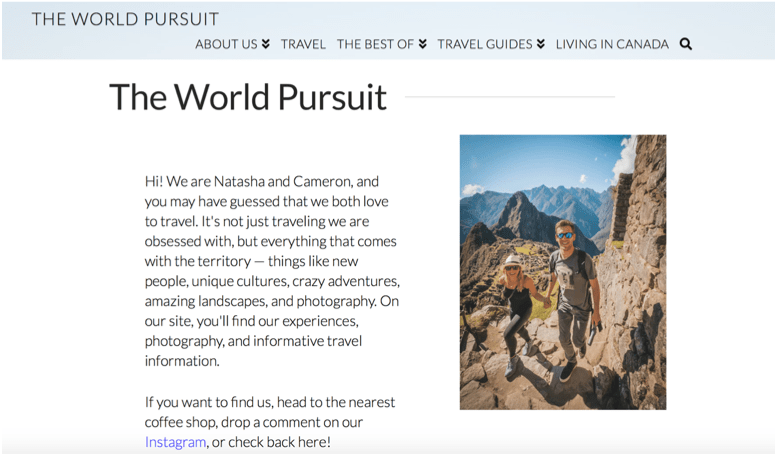
The tourism sector is one of the fastest growing economic sectors in the world (Hojeghan and Esfangareh, 2011), and the digital economy has no doubt been a key driver in its expansion (Bearne, 2016). The travel agent has gradually been shifted to the side – the collapse of Thomas Cook last year is a prime example. The world’s oldest travel company going bust sparked debate around the relevancy of travel agents in this new era of digitalisation (Bearne, 2016). The internet has allowed individuals to book their flights, accommodation and places to eat all at the click of a button. Individuals are able to plan every aspect of their holiday for themselves with minimal risk – online reviews and pictures are utilised before they even arrive in a country. The way people travel has fundamentally changed. Consumers no longer want to be confined to the restrictions of a travel agents all-inclusive booking system. People have become more exposed to other countries and cultures via social media and blogs that are dedicated to travel. They provide tips and tricks for readers to travel independently, such as this blog called The World Pursuit.
A travel consultant is traditionally the person in the travel agent that organises and promotes all the aspects of a holiday for their customers, including flights and accommodation. Airbnb is an online platform that allows travellers and holidaymakers to organise to stay in local people’s homes. It has accentuated the trend towards “authentic” experiences (Nevill, 2018). People have started to crave local experiences from novel cultures. Independent travelling has becomes the new craze. Does this mean the travel consultant has become outdated?
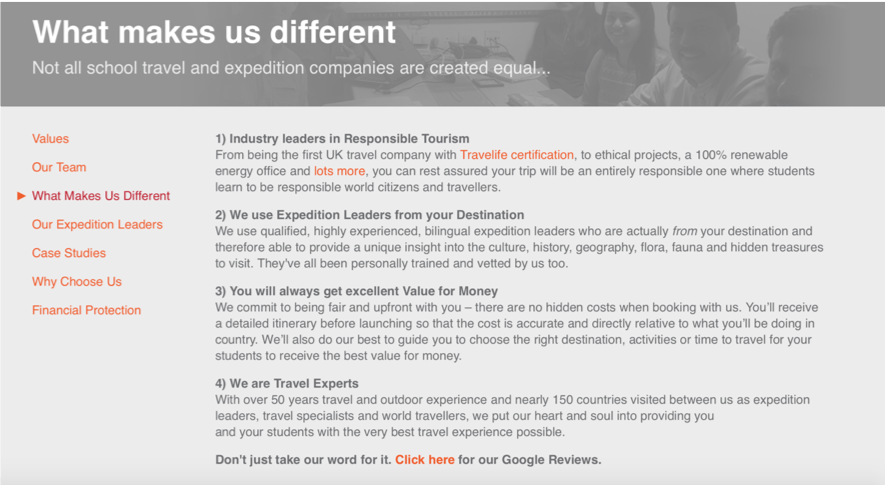
The travel consultant role interests me because I work for a small independent travel company which organises ethical overseas expeditions for schools all over the UK and further afield called STC Expeditions. They offer a tailored experience, taking into account the schools specific demands. They have only been around a relatively short amount of time in terms of the travel and tourism economy. They therefore set up their business during the digital economy period – the company has all its database online and is able to make contacts online. The travel consultant still has to travel themselves to solidify relationships and make sure the places are how they are described. Digitalisation has made it easier to forge these connections, but does not get rid of the need to visit these countries before the customers. The internet has enhanced the travel industry in this way. It has allowed travel consultants to access more remote areas and businesses to offer their customers more unique and “authentic” experiences.
The slight spanner in the works is that for these connections to be made, the countries they are forming relationships with need to be part of the digitalised economy too. Remote areas in Africa have been left out of the tourism boom that has helped other parts of Africa (Nevill, 2018). This is because they are not developed enough to offer the standards of cleanliness and comfort for tourists, and they also do not have the technology to forge the contacts with the travel consultants (Nevill, 2018). In a sense, this could be an avenue for travel consultants to access in the future – the most remote areas in developing countries. This may require greater investment into travelling further afield to discover these hidden gems. There are also suggestions of travel consultants changing their title to travel ‘advisors’ – a transition to organising every detail of someone’s holiday or business trip (Elliot, 2018). For example, making restaurant reservations and sorting out all of the customer’s documents (Elliot, 2018).
When I was at school, I went on an overseas expedition to Morocco which was organised by another independent expeditions company. Looking back the relevance of travel consultants that organise trips for big organisations such as schools and businesses will never be outdated. Neither the student, the parents nor the teacher would ever plan an overseas trip from scratch – it simply is not their job. There are still organisations that require travel consultants to plan their trips for them – the demands have just changed slightly.
Despite the slow demise of the travel agent, the travel consultant is not dead in the water just yet. The digital economy has arguably enabled the travel consultant to access a larger proportion of travel destinations. The travel agents and its consultants have of course had to undergo significant changes – those that have moved with the times have survived and those stuck in the past have not lasted. The digitalising economy has allowed companies to forge contacts with independent overseas companies to offer new and personalised cultural experiences to their customers. In the future, it is possible they will create contact with even more remote areas as they start to develop. There may also be a shift towards holiday planning for organisations, rather than families – a switch from the ‘travel consultant’ to the ‘travel advisor’.

 Digital Business Models